

Thankstaking
This Thanksgiving, I'm thankful for American history.

On Nov. 21, 1620, a ship sailed in from the east.
Battered by storms and thrown off course, the incoming passengers washed up on Cape Harbour, what is now Provincetown. The colonists found a deserted settlement previously home to the Wampanoag tribe.
The tribe left the village years earlier to escape a disease known as the Great Dying - a disease brought to the Americas by Europeans.
About a month later, the colonists left Provincetown and arrived at Plymouth Bay, Mass. While the settlers were happy to be on land, they were not prepared for the harsh winter to come.
Food was scarce, but illness was abundant. At the end of winter, nearly half of the 102 Mayflower passengers lost their lives.
In March 1621, Wampanoag leader Massasoit Sachem sent English-speaking Native Americans Samoset and Tisquantum (Squanto), to aid the struggling settlers.
The meeting led to a peace treaty between the Pilgrims the Wampanoag tribe.
This alliance had a symbiotic relationship: The Pilgrims needed to avoid starvation, so the natives taught them how to hunt and grow food from the land. The Pilgrims, in turn, helped the Wampanoag help fend off rival tribes.
In autumn 1621, the colonists celebrated with a three-day festival of prayer. The 53 Pilgrims feasted with 90 natives, in what would become the first Thanksgiving.
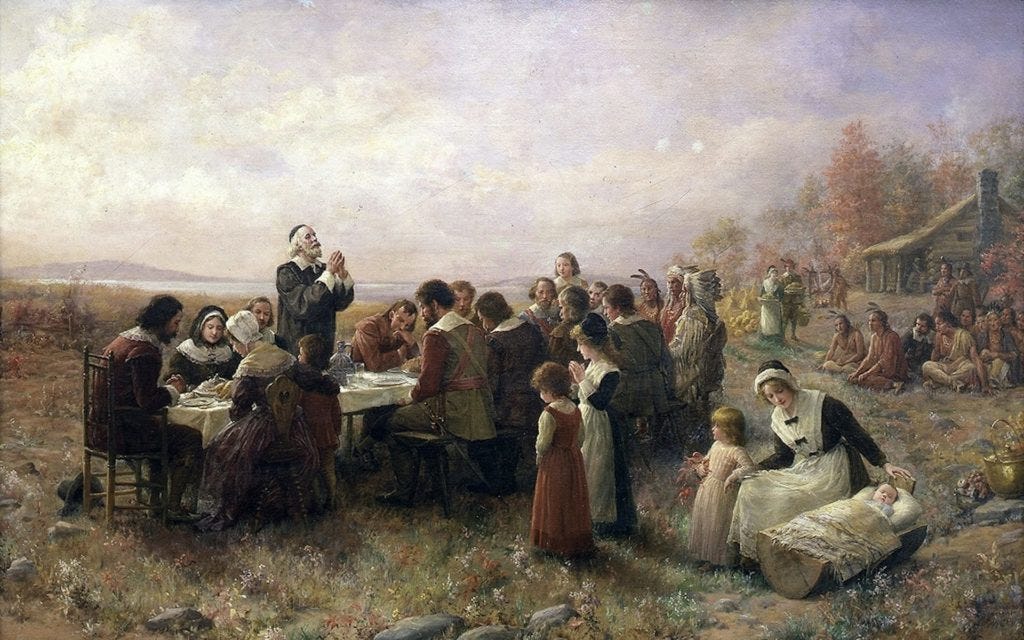
Edward Winslow, a significant architect in the Mayflower’s voyage and a skilled diplomat in relation with Native Americans, wrote about the feast:
“Our harvest being gotten in, our governor sent four men on fowling, that so we might after a special manner rejoice together, after we had gathered the fruits of our labors; they four in one day killed as much fowl, as with a little help beside, served the company almost a week, at which time amongst other recreations, we exercised our arms, many of the Indians coming amongst us, and amongst the rest their greatest king Massasoit, with some ninety men, whom for three days we entertained and feasted, and they went out and killed five deer, which they brought to the plantation and bestowed on our Governor, and upon the Captain and others.
Winslow would go on to thank the “goodness of God” for the harvest. In his writings, it is not implied the natives were invited to the feast for good vibes.
Winslow wrote about their yield: a good crop of corn and barley, inedible peas. Notice how the Native Americans brought deer after the settlers were feasting on fowl.
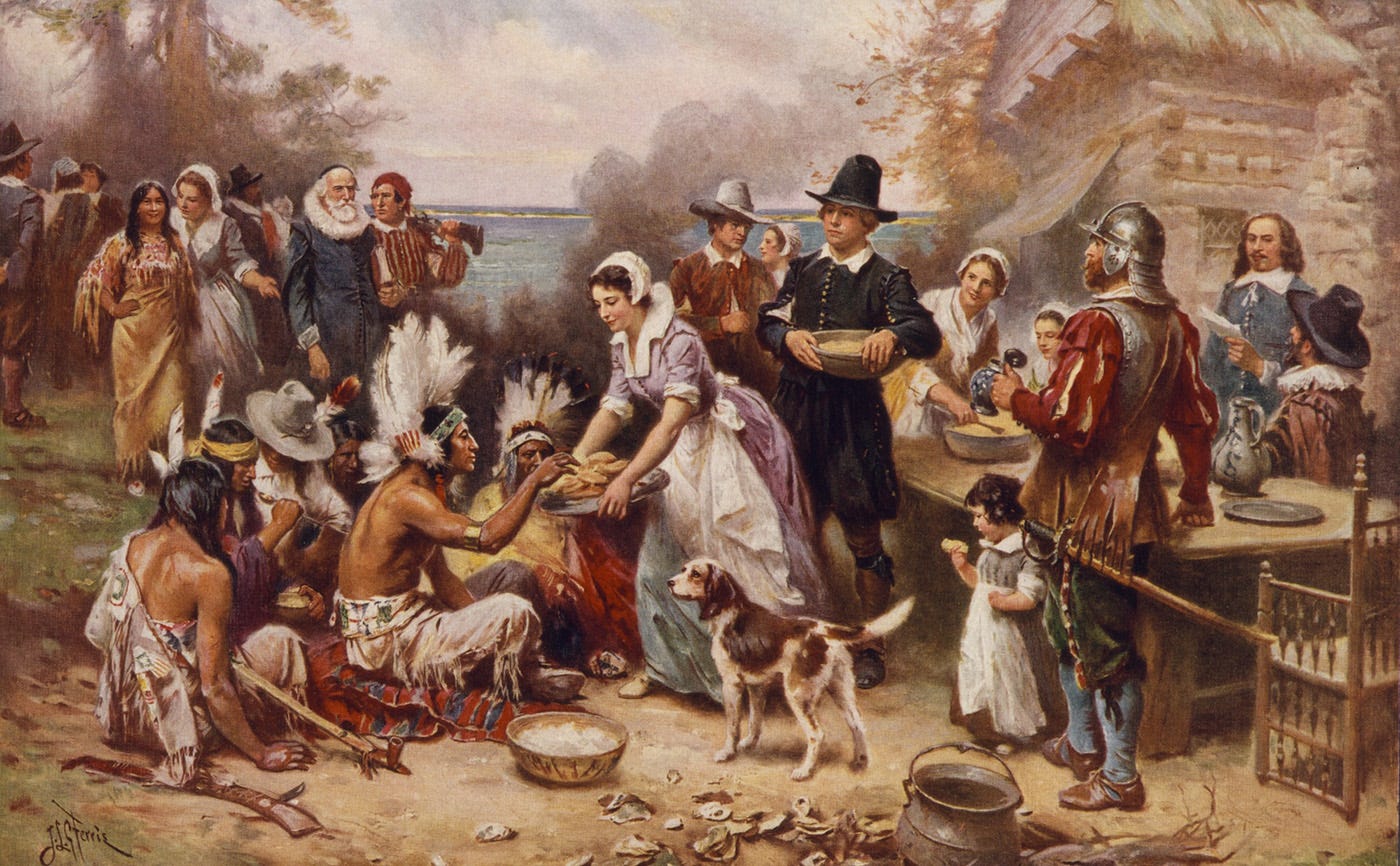
As the years passed, more colonists began to arrive. The colonists encroached on native land, expanding with of brute force.
This would lead to one of the deadliest wars in American history (King Philip’s War).
“This action by Massasoit was perhaps our biggest mistake. We, the Wampanoag, welcomed you, the white man, with open arms, little knowing that it was the beginning of the end.”
-Frank James, Wampanoag leader (1970)
But let’s forget all that.
I need to go to the store to buy some produce.
I’m making carrots with goat cheese and pomegranate seeds for Thanksgiving. The way my forefathers intended.